
Custom Jewelry Wholesale: Plating Options and Their Limits
The plating build: stainless steel finished with PVD vacuum plating, rhodium, 14K, 18K or 24K gold and an anti-tarnish e-coat on silver and brass.

Key takeaways
- Published finishes are 14K, 18K and 24K gold plus rhodium, applied as multi-layer electroplating.
- Silver and brass take an additional anti-tarnish e-coating; stainless steel uses PVD vacuum plating instead.
- Hallmarks are laser engraved as an S925 stamp, an 18KGP mark on plated work and 316L for stainless steel to match the claim on the listing.
- CAD sampling at count count count count 25–30 days for sampling, 3–4 weeks for production, 48 hours for CAD for CAD for CAD (run) for CAD set the plating schedule.
What the published plating menu actually offers
Four precious-metal finishes are listed: 14K gold, 18K gold, 24K gold and rhodium. All are applied as multi-layer electroplating, and the layer count is described as multi-layer rather than quoted in microns. For a buyer, that means the colour is specified but the durability has to be discussed rather than read off a spec sheet.
Rhodium is the odd one out in that menu. It is a white finish used for brightness and wear resistance rather than a gold tone, so a piece quoted in rhodium should be checked against the reference sample for colour temperature, because two suppliers can both say rhodium and deliver slightly different whites.
Protective layers are material-specific
The protective top layer is decided by the base metal rather than by preference. Silver and brass pieces receive an anti-tarnish e-coating on top of the plating, which slows the reaction that dulls a finished surface in air and handling. Stainless steel does not use the same route at all: it is finished with PVD vacuum plating, a different process on a different line.
That gives three base metals two finishing families: 2 of 3 materials run through electroplating plus e-coating, and 1 of 3 goes to PVD. A mixed-metal collection therefore has two separate finishing schedules, which is worth knowing when a restock has to be split across metals.
Where plating meets the restriction list
Finishes are also a compliance question, because the layer sits against skin. The published REACH statement covers lead, cadmium and nickel across materials, and the plating is stated as compliant with REACH and California Proposition 65 limits. For pieces designed for daily wear, the nickel restriction is the one that generates the most questions from retail partners.
Pair the compliance statement with the hallmark. Purity marks are applied by high-precision laser engraving as S925 for silver, 316L for stainless steel and 18KGP for gold-plated pieces. If a product listing claims a material, the engraved mark is where that claim becomes verifiable, so agree the wording of the mark at the same time as the plating selection.
| Base material | Published finish route | Hallmark |
|---|---|---|
| 925 sterling silver | Multi-layer gold or rhodium plating plus anti-tarnish e-coating | S925 |
| Artisan eco-brass | Multi-layer gold or rhodium plating plus anti-tarnish e-coating | 18KGP for gold-plated pieces |
| Stainless steel | PVD vacuum plating | 316L |
| Finish colours | 14K, 18K and 24K gold, or rhodium | Applied by laser engraving |
What to ask when a thickness is not published
Because the published material describes the stack as multi-layer and does not give a micron figure, the burden shifts to the question you ask. Ask how many layers are applied on the finish you have chosen, what the piece is expected to withstand in normal wear, and whether the reference sample in your hand carries the same stack as the production run.
Ask the same question of a competitor and the difference becomes obvious. A vague answer from one supplier and a described process from another tells you more about the finished piece than any comparison of colour swatches, and it costs nothing to ask before an order rather than after a batch of returns. That holds whether you are buying one plated style or sourcing through a custom jewelry wholesale supplier across several metals; the published MOQ floors of 50, 100 and 100+ pieces are counted per design rather than per finish.
Worked example: where the drawing sits in a plating decision
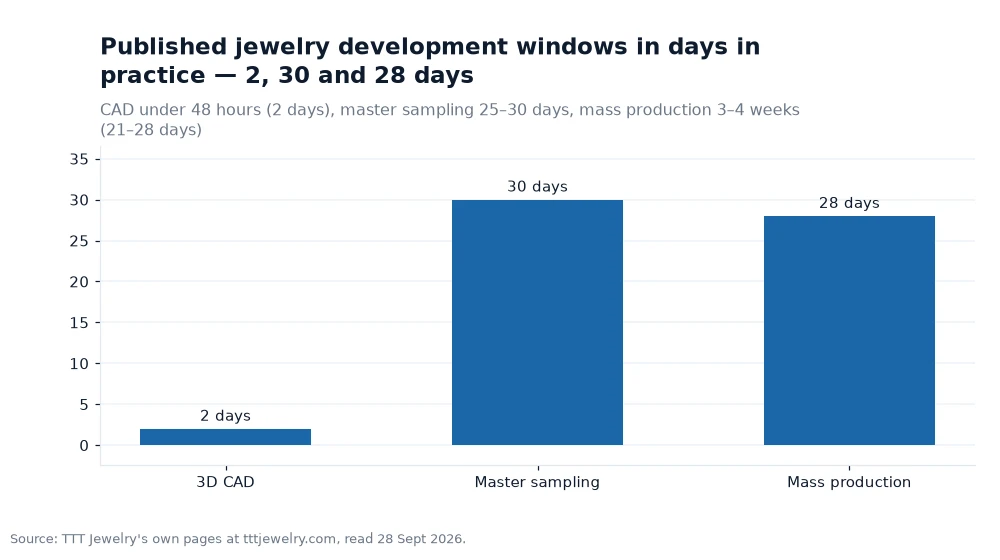
Put the published windows in sequence. CAD takes under 48 hours, which is 2 days. The master sample takes 25–30 days and bulk production 3–4 weeks, or 28 days at the four-week end. The full development calendar is therefore about 2 + 30 + 28 = 60 days at its slowest, and the drawing stage is 2 ÷ 60 = 3.3% of that total.
Three per cent of the schedule is where the finish is chosen, and it is the only stage where a change costs screen time instead of a plating tank run. Settling the gold tone and the protective layer during CAD rather than after the sample is the single least expensive scheduling decision available, and it is the reason the published workflow puts dimensional sign-off before the wax is printed.
Reading a plated sample correctly
Judge a plated sample under the light your customer will see it in. Workshop lamps flatten colour differences, so a gold tone that looks correct on the bench can read as pale or brassy in daylight. The published sampling window includes custom electroplating as one of five operations, which means the finish on the master sample is the finish on the approved piece — there is no later stage where a tone is corrected.
Handle the sample as well as look at it. A protective e-coating on silver or brass is there to resist tarnish from skin contact and display, and PVD on stainless steel is there for wear. Neither replaces the underlying metal choice, which is why the finishing decision is made after the base material rather than instead of it.
Frequently asked questions
Which finishes can I choose for a plated piece?
The published menu is PVD vacuum plating on stainless steel, an anti-tarnish e-coat on silver and brass, rhodium plating and multi-layer gold in 14K, 18K and 24K.
How thick is the plating?
The published material describes the stack as multi-layer and does not state a micron figure, so thickness is a question for the supplier rather than a published specification.
Does plating change the sampling schedule?
No. Custom electroplating is one of the operations inside the 25–30 day master sample window, and CAD still comes back in under 48 hours before it.
Choosing a finish you can stand behind
Decide the gold tone, the protective layer and the hallmark in one go, and write all three into the brief so the sample carries them from the start. If a plated look is carrying the volume of your range, compare it with the plated brass jewelry line before you lock the price points, and settle any remaining questions using the FAQ section on finishes.
The basis for every figure above — the five packaging items / the five-step service flow, the six customisation fields — is the factory's own site through tttjewelry.com, checked 28 Sept 2026. The certification set is ISO 9001:2015, a BSCI audit and REACH limits on lead, cadmium and nickel. No figure above is estimated. The order-of-magnitude reading is mine — the site supplies the inputs only [1]