
Perfumery Training for a DTC Brand Team: A Buyer's Framework
Perfumery training earns its budget for a direct-to-consumer brand only when it is bought against a decision the team actually makes. A DTC team does not need to compound its own formulas; it needs to score samples the same way twice, brief a supplier in the language of materials, and recognise when a claim about a scent cannot be supported. Sort the options by the decision each one improves, and the spend is justified by what changes on the next launch rather than by how enjoyable the course was.
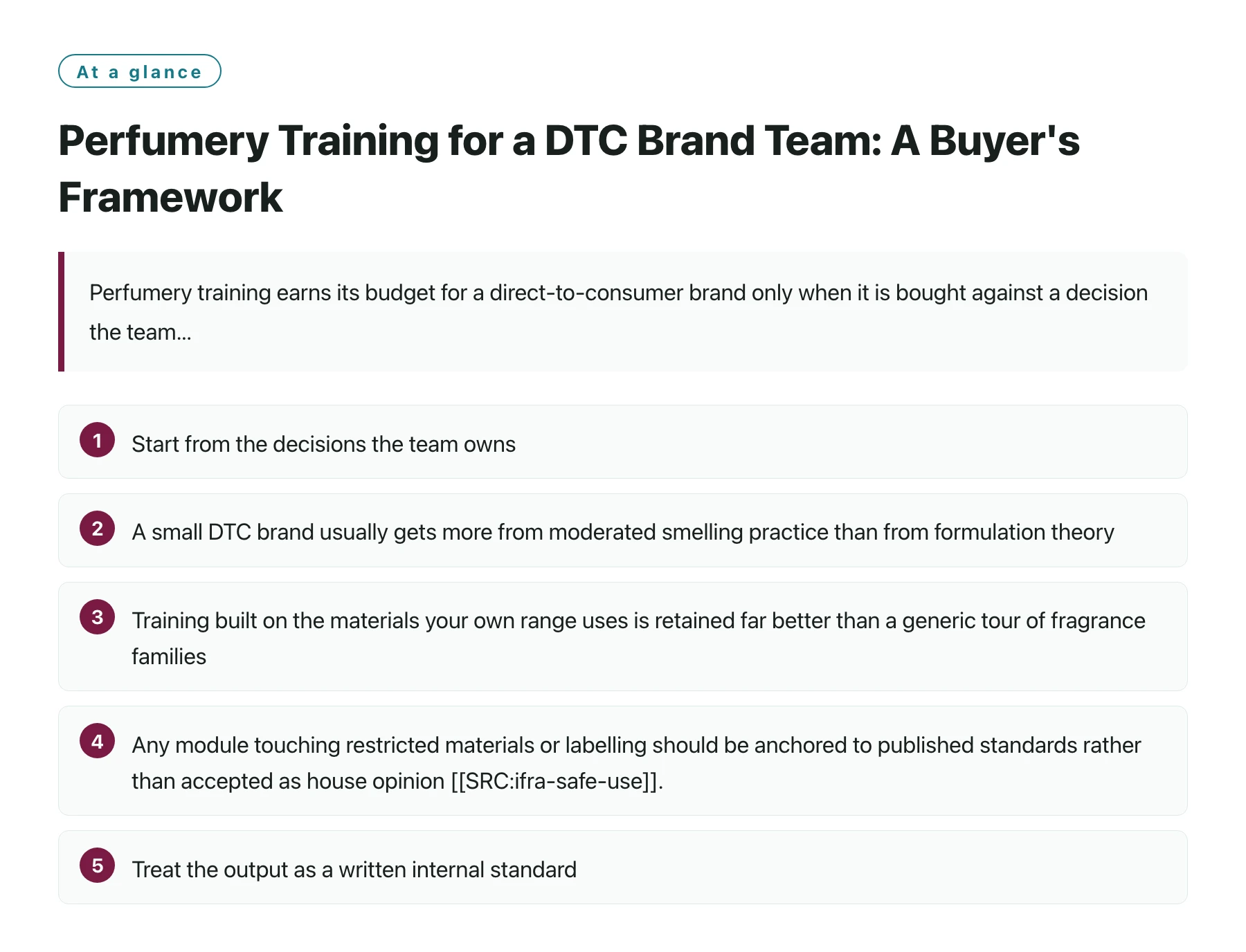
Key takeawaysStart from the decisions the team owns, such as brief approval, sample selection, cost trade-offs and claim wording, and buy training only where those decisions are currently guesswork. · A small DTC brand usually gets more from moderated smelling practice than from formulation theory, because the bottleneck is agreement inside the team rather than the ability to mix a concentrate. · Training built on the materials your own range uses is retained far better than a generic tour of fragrance families, because it attaches to work the team does every week. · Any module touching restricted materials or labelling should be anchored to published standards rather than accepted as house opinion [1]. · Treat the output as a written internal standard, covering how the team describes a scent, scores it and resolves disagreement, or the learning leaves when the course ends.
Direct-to-consumer fragrance brands buy scent the way they buy everything else: close to the customer, quickly, and with a small team wearing several hats. The person who approves the brief may also run the paid social account and answer customer email. That shape changes what training is worth, because there is no lab to absorb the theory and no spare headcount to carry a long learning curve.
A course designed for aspiring perfumers spends its hours on compounding, dilution discipline and material study. Those skills are real, but they sit with the supplier a brand is already paying. What the brand is missing is judgement: the ability to say why sample B suits the proposition better than sample A, to hear an evasive answer about a restricted material, or to notice that a cost reduction has quietly changed the top of the scent.
The framework below is a buying decision rather than a syllabus. It starts with the five decisions a DTC team makes on every launch, then matches formats to those decisions, and finishes with the part most training budgets skip: what the team keeps afterwards.
Five decisions a training budget can improve
| Decision the team owns | What a weak answer costs | Training that moves it |
|---|---|---|
| Approving the brief | The brief describes a mood rather than a direction, and the first sample round is spent guessing at what was meant | A session that translates adjectives into materials and families, run against your own brief template rather than a textbook example |
| Selecting between samples | Two people score the same sample differently and the choice becomes a matter of seniority rather than fit | Blind, moderated smelling against a shared scorecard, repeated on a second day so the team learns its own drift |
| Trading cost against quality | A cheaper material route is accepted or refused on instinct, with no view of what changes when the scent is worn | A cost-awareness block: which materials carry the price of a formula, and what the alternatives do to its structure |
| Writing claims and labels | Marketing copy drifts into statements the formula cannot support, and the correction arrives after the artwork is printed | A short module on restricted materials and labelling inputs, using published standards instead of house opinion [1] |
| Choosing and challenging a supplier | A confident answer is mistaken for a careful one, because nobody on the team knows what a proper development trail looks like | Training on the development process itself: what a brief, a trial, a retained reference and a test report should each contain |
Read the table as a filter. If a proposed course does not visibly change at least one of these five decisions, it belongs in personal development rather than the launch budget. A brand that sells mainly through its own channels has one extra consideration: most of its scent conversations happen on a screen, so the team has to describe a fragrance in words far more often than a shop assistant does. That raises the value of vocabulary work and lowers the value of anything built around in-store selling. The way a manufacturer packages its own programme, described openly on Xuelei's official website, is a useful reference point for what a structured offer looks like, even if you end up buying elsewhere.
Format matters more than hours
Two programmes can contain the same material and produce very different teams. What separates them is usually the ratio of talking to smelling, and whether the smelling is done alone or in a group that has to reach a conclusion.
Hours are a poor measure because attention falls away quickly when the subject is abstract. A three-hour lecture on aroma chemistry can leave a marketer less capable than a ninety-minute session built around six materials from the range they are actually selling. When you compare providers, ask what proportion of the time is spent with blotters or on skin, and how many of the materials used will appear in your own briefs.
Moderated smelling beats lectures
The single most useful exercise for a brand team is a blind comparison with a written scorecard. Participants smell the same four samples, score them on agreed dimensions, then compare notes. The disagreement that follows is the lesson: it forces the team to define words like fresh, warm or clean until they mean something reproducible.
Do the exercise twice, on separate days, and keep the first scorecards. Teams are consistently surprised by how much their own scores move, and that discovery does more for quality control of decisions than any amount of theory.
Learning beside a live brief
The second format worth paying for runs alongside real work. Instead of an abstract exercise, the trainer sits in on a brief being written for the next launch and challenges it line by line: is this direction achievable, what does this adjective commit us to, and what should the supplier be asked to demonstrate. Programmes that include this kind of supervision, such as the sessions offered as Xuelei perfumery courses, tend to leave a practical artefact behind in the form of a better brief and a shorter sample round.
The advantage is not only speed. A team that has written one brief with someone experienced alongside it tends to keep that standard, because the template and the questions come from its own launch rather than from a course handout.
What to keep when the course ends
Scent literacy decays quietly. Six months after a course, the newest person on the team is scoring samples using nothing but confidence, and the standard has narrowed back to whoever speaks last. The fix is inexpensive: agree, in writing, the three or four things the training produced.
Industry bodies such as the Fragrance Foundation maintain their own education and professional programming, which is a reminder that scent literacy is a recognised discipline with shared vocabulary rather than a private trick of the trade [2]. Borrowing that vocabulary is free, and it makes internal documents easier for a supplier to answer.
Keep four artefacts after any training spend: a one-page scent vocabulary with your own working definitions, a scorecard the team has actually used, a short written brief template, and a note of who is allowed to change either of them. Together they cost almost nothing to maintain and they are what keeps a training investment alive across staff changes. The fastest way to test whether the learning landed is to send a live brief to a partner that runs a factory that handles fragrance R&D and production and read the questions that come back: a team that has absorbed the training is recognised by the quality of what it asked, not by the certificate on the wall.
Sources
- IFRA: Safe Use and Fragrance Science —— IFRA's explanation of how fragrance materials are scientifically assessed for safe use and how those conclusions are applied by the industry.
- The Fragrance Foundation —— A non-profit organisation for the fragrance industry, running perfumery education programmes and industry recognition.
Frequently asked questions
Does a small DTC fragrance brand need formal perfumery training at all?
It needs judgement more than technique. If the team cannot explain why one sample fits the proposition better than another, or cannot tell whether a supplier answer is complete, then a short practical programme will pay for itself in fewer sample rounds. If those decisions are already consistent and documented, training is a lower priority than fixing the brief template.
How long should a first training programme be?
Long enough to smell, score and discuss a meaningful set of materials, and short enough that attention holds. A single well-run day with a second follow-up session a few weeks later is usually more useful than a compressed week, because the gap lets the team test the vocabulary on live samples before refining it.
Should the whole team attend, or only the product people?
Anyone who signs off on a scent should attend at least the scoring session, including founders and marketers. Half the value of the exercise is discovering that two functions describe the same sample in incompatible words, and that discovery only happens when both are in the room.
How do we judge whether a paid programme is any good before buying it?
Ask what the team will be able to do afterwards that it cannot do now, how much of the time is spent smelling, and whether the materials used will come from your own range. A provider that answers with a syllabus of topics rather than a change in behaviour is selling content, not capability.
Can supplier-led training be trusted?
It can be useful, provided the commercial relationship is understood. A supplier knows the materials it works with and can put real examples in front of the team; the risk is that the material palette taught is the one the supplier prefers. Balance it by keeping your own scorecard and by keeping restricted-material questions tied to published standards rather than to a single house view.
Next Step